
Avocadonomics: Hidden Carbon Footprint of Avacado

Avocados have captured hearts and plates worldwide, earning their reputation as a nutritious "superfruit" packed with healthy fats and essential nutrients. However, as global demand continues to rise, it's worth examining the environmental story behind this beloved fruit. I am coining the term "avocadonomics" it refers to the economic and environmental dynamics of super fruit Avocado experiencing explosive global popularity.
History : From Ancient Fruit to Global Commodity
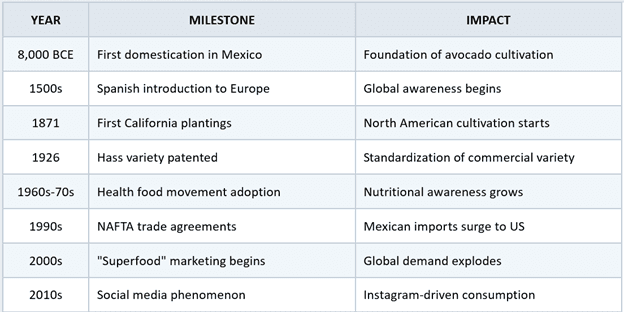
To understand the modern avocado phenomenon, we must first appreciate its remarkable history. The avocado (Persea americana) has been cultivating relationships with humans for over 10,000 years, beginning in the highlands of south-central Mexico¹. Archaeological evidence suggests that indigenous peoples in the Tehuacán Valley were among the first to domesticate this fruit around 8,000 BCE.
Ancient Origins and Cultural Significance
The Aztecs called it "āhuacatl," meaning "testicle tree" due to the fruit's shape and the way it hangs from branches. They revered avocados not just as food but as a symbol of fertility and love. The fruit was so valued that Aztec warriors would consume avocados before battle, believing they provided strength and vitality². Spanish conquistadors encountered avocados in the 16th century and introduced them to Europe, though the fruit remained largely exotic and expensive. The name "avocado" itself is a linguistic evolution from the original Nahuatl word through Spanish "aguacate."
The California Gold Rush
The modern avocado story begins in earnest during the California Gold Rush era. In 1871, Judge R.B. Ord planted the first avocado tree in Santa Barbara, California, using seeds from Mexico³. However, it wasn't until 1926 that Rudolph Hass, a postman carrier in La Habra Heights, California, patented what would become the world's most popular avocado variety. Also known as Hass Avocado which accounts 80% of all the avocado eaten worldwide. Refer to https://californiaavocado.com/avocado101/the-history-of-california-avocados/
Understanding Avocadonomics
Avocados have transformed from a regional specialty to a $13 billion global industry, with consumption in the United States alone increasing by over 400% since the 1990s¹. While avocados offer genuine nutritional benefits, emerging research suggests their environmental footprint may be disproportionately large compared to other nutrient-dense alternatives. This doesn't mean we should eliminate avocados entirely, but rather approach them with greater awareness of their climate implications.
This rapid expansion has led to:
Conversion of diverse agricultural landscapes into monoculture orchards
Intensive resource extraction in water-stressed regions
Long-distance supply chains spanning continents
Significant social and environmental impacts in producing regions
Research from the Center for Research on Injustice highlights how regions like Michoacán, Mexico, have experienced deforestation, water stress, and complex socioeconomic changes due to avocado boom7. Refer to article published in NewYork Times on 28th, Nov 2023 https://www.nytimes.com/2023/11/28/us/mexico-avocado-deforestation.html
Climate and Environmental Impact Analysis
Carbon Footprint Comparision. The environmental impact of avocados becomes clearer when compared to nutritionally similar foods:
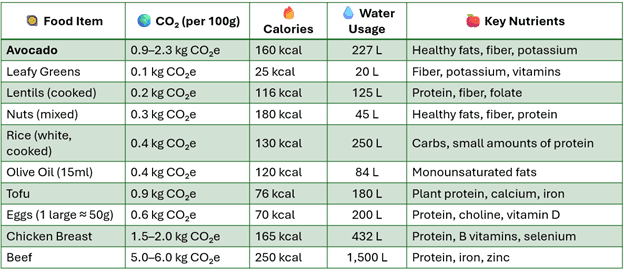
Sources: 8Life Cycle Assessment studies, Hildebrandt et al., 2021; 9Water Footprint Network, 2019
Land Use and Biodiversity Impact
Avocado cultivation often involves:
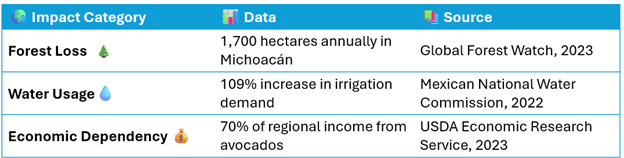
Deforestation: Studies show that 20% of avocado expansion in Mexico occurs in forested areas10
Monoculture farming: Replacing biodiverse agricultural systems
Habitat fragmentation: Affecting local wildlife corridors
Water Stress Considerations
Avocados are notably water-intensive:
Require 227 liters of water per 100g of fruit9
Often grown in arid regions already facing water scarcity
Can strain local water resources, competing with community needs
Nutritional Value vs. Environmental Trade-offs
Avocados are genuinely nutritious, providing:
Monounsaturated fats (beneficial for heart health)
Fiber (supporting digestive health)
Potassium (important for blood pressure regulation)
Folate, vitamin K, and vitamin E
Nutritional Alternatives with Lower Climate Impact
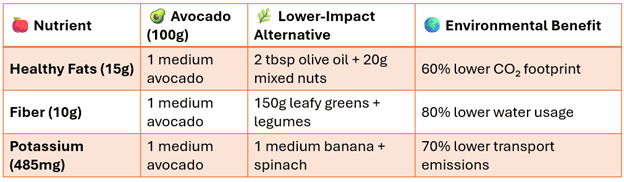
Data compiled from USDA Nutrient Database and LCA studies, 2023
Research from Harvard's School of Public Health confirms that these nutritional needs can be met effectively through diverse, lower-impact food combinations11 .
Regional Impact: A Closer Look
Mexico produces 80% of the world's avocados, with significant consequences:
Global Supply Chain Emissions
Transportation contributes significantly to avocados' carbon footprint:
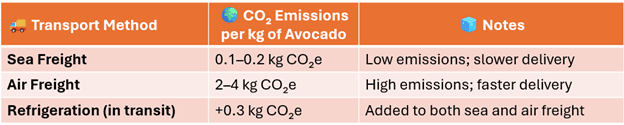
Data from International Maritime Organization and IPCC Transport Guidelines, 2022
Finding Balance: Practical Recommendations
For Consumers
Choose seasonal and local when possible: Reduces transportation emissions
Practice moderation: Enjoy avocados as an occasional treat rather than daily staple
Explore alternatives: Try tahini, nut butters, or olive-based spreads for similar nutrition
For Food Industry
Improve traceability: Implement supply chain monitoring systems
Support sustainable farming: Partner with producers using agroforestry practices
Diversify sourcing: Reduce dependency on single regions
Conclusion: Mindful Enjoyment
Avocados need not disappear from our plates entirely, but their environmental cost suggests they should be treated more like a specialty ingredient than a dietary staple. By understanding avocadonomics, we can make more informed choices both our health and our planet's wellbeing.
When we do choose avocados, we can select sources committed to sustainable practices and enjoy them mindfully, knowing their true cost. Meanwhile, exploring the rich world of nutritious, lower-impact alternatives can expand our culinary horizons while reducing our environmental footprint.
As we navigate the complex relationship between nutrition and climate impact, the avocado serves as a valuable case study in the hidden costs of our globalized food system. By choosing thoughtfully and eating diversely, we can nourish ourselves while being better stewards of the environment.

References
Hass Avocado Board. (2023). Avocado Consumption Data and Statistics. California Avocado Commission Annual Report.
California Avocado Society. (2022). Historical Timeline of Avocado Cultivation. Available at: californiaavocadosociety.org
USDA Agricultural History Archives. (2021). Early Avocado Introduction to United States. National Agricultural Library.
Avocados from Mexico Marketing Association. (2023). Campaign Impact Studies 2000-2023. Industry Marketing Report.
Hass Avocado Board. (2023). Avocado Consumption Data and Statistics. California Avocado Commission Annual Report.
FAO Statistical Database. (2023). Global Avocado Production Trends 1990-2020. Food and Agriculture Organization of the United Nations.
Center for Research on Injustice. (2023). Unholy Guacamole: The Social and Environmental Cost of Avocado Production. Available at: cri.org
Hildebrandt, J., et al. (2021). "Life cycle assessment of avocado production systems." Journal of Cleaner Production, 312, 127-138.
Water Footprint Network. (2019). The Water Footprint of Crops and Derived Crop Products. UNESCO-IHE Institute for Water Education.
Tapia-Armijos, M. F., et al. (2023). "Deforestation and avocado expansion in Mexico." Environmental Research Letters, 18(4), 044-056.
Harvard T.H. Chan School of Public Health. (2023). The Nutrition Source: Healthy Eating Plate. Available at: hsph.harvard.edu/nutritionsource
Global Forest Watch. (2023). Mexico Forest Loss Data. World Resources Institute.